Are duplexes and small multifamily properties in St. Petersburg still worth a serious look? For many buyers and investors, the answer is yes, but only when you study the numbers, the zoning, and the flood profile with care. If you want a practical view of how these properties work in today’s market, this guide will help you understand what to watch, where the opportunity may be, and how to approach the process with more confidence. Let’s dive in.
Why St. Petersburg draws multifamily buyers
St. Petersburg has an active market for duplexes, triplexes, quadplexes, and other small income properties. Current portal data shows 52 multifamily homes for sale in the city with a median listing price of about $597,000, while average rent is around $2,125. That combination puts small multifamily in an interesting middle ground for buyers who want rental income without stepping into large apartment ownership.
This property type is still a smaller slice of the rental market than larger apartment communities or single-family rentals. HUD found that about 5% of occupied rental units in the broader Tampa-St. Petersburg-Clearwater market were in 2-to-4-unit structures in 2022. So while duplexes and fourplexes are not the dominant rental format, they are a real and established part of the local housing stock.
St. Petersburg is also planning for more multifamily housing over time. The city’s Housing Opportunities for All materials state a goal of creating and preserving 3,200 more multifamily units. For buyers, that reinforces the idea that multifamily housing remains part of the city’s long-term housing strategy.
What small multifamily looks like here
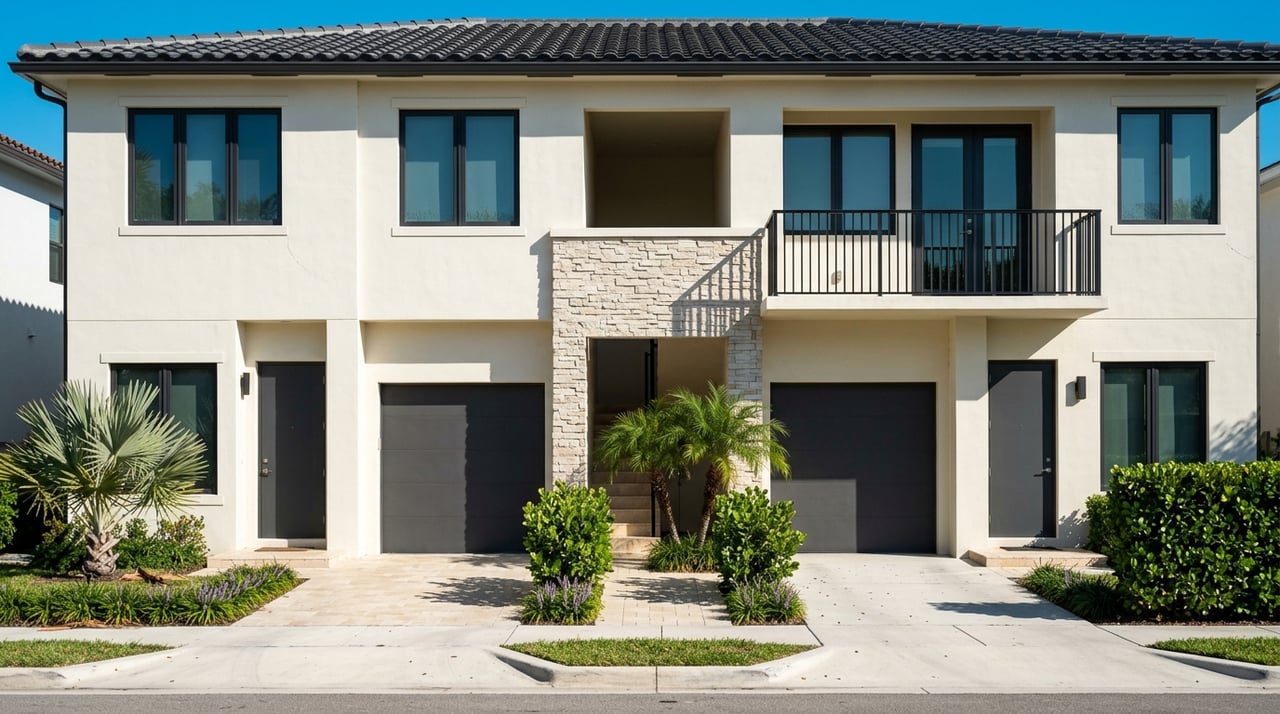
In St. Petersburg, small multifamily does not mean one standard building type. Current listings show a mix of side-by-side duplexes, front-back duplexes, quadplexes, and hybrid properties that combine a house with additional rental units.
That variety matters because two properties with the same unit count can operate very differently. One may be a straightforward duplex, while another may be a front house with a rear duplex added later. The layout, parking, lot shape, and legal use can all affect financing, rent potential, and future flexibility.
A few recent examples from current listings show the range:
- A duplex at 2983 62nd Ave N with two 2-bedroom, 2-bath units listed at $559,000
- A quadplex at 1761 19th St S with four 2-bedroom, 1-bath units
- A 3-unit property at 2844 30th Ave N that combines a renovated front house with a new-construction duplex in the rear
Why zoning review matters
With small multifamily, you should never assume a property’s current setup tells the full legal story. St. Petersburg’s code specifically addresses parcels in zoning districts that allow duplex, triplex, quadraplex, townhome, or other multifamily residential development. The code also separately recognizes accessory dwelling units in some single-family districts.
That means your due diligence should go beyond the listing description. Before you move forward, confirm the legal use of the property, how the parcel is configured, and whether parking and other site requirements line up with the current use. This is especially important with older properties or homes that may have been converted over time.
Understanding the rent-to-price picture
One reason St. Petersburg duplexes and small multifamily continue to get attention is the local rent backdrop. Zillow shows average rent in St. Petersburg at $2,125. The University of Florida’s 2026 Pinellas County fair market rent table lists $1,977 for a 2-bedroom unit and $2,527 for a 3-bedroom unit.
Those benchmarks suggest that well-positioned 2-bedroom and 3-bedroom units can support meaningful rent levels, but performance is not uniform from one property to the next. Renovation level, unit size, location within the city, parking, and insurance costs can all change the math quickly.
A simple example helps show how buyers often look at these deals. Zillow estimates market rents of about $2,150 per unit for the duplex at 2983 62nd Ave N, against a $559,000 list price. On a basic gross basis, that works out to about 9.2% annual rent-to-price before expenses.
Another current listing, a 4-plex at 1761 19th St S, shows current rents of $6,757 per month with a higher upside estimate based on fair market rent benchmarks. That is one reason many St. Petersburg buyers underwrite small multifamily as a value-add play rather than assuming every property is already optimized on day one.
Gross numbers are only the start
Headline rents can catch your attention, but they do not tell you what a property will actually feel like to own. In St. Petersburg, your net performance may depend more on operating costs than on the advertised rent roll.
That is especially true when you factor in insurance, maintenance, vacancy, turnover, and possible capital improvements. A property that looks strong at first glance may feel much tighter after real-world expenses are added in. That is why careful underwriting matters so much in this segment.
Financing can be more flexible than many buyers expect
One of the more encouraging parts of the St. Petersburg small multifamily market is that many listings appear to fit within standard residential loan limits. Since the current median multifamily asking price is around $597,000, a substantial share of inventory appears to fall inside common financing bands for 2-to-4-unit residential properties.
For owner-occupants, financing can be especially favorable. Fannie Mae’s current matrix allows up to 95% loan-to-value on a 2-to-4-unit principal residence, while a 2-to-4-unit investment property is limited to 75% loan-to-value. HUD also states that FHA down payments can be as low as 3.5% on 1-to-4-unit properties.
That creates a meaningful difference between house hacking and pure investment buying. If you plan to live in one unit and rent the others, you may have access to a lower down payment path than an investor buying a non-owner-occupied property.
Local loan limits in Pinellas County
Pinellas County’s 2026 FHA forward limits are:
- 2 units: $693,050
- 3 units: $837,700
- 4 units: $1,041,125
The 2026 conforming loan limits for Pinellas County are:
- 2 units: $1,066,250
- 3 units: $1,288,800
- 4 units: $1,601,750
These limits do not guarantee approval, of course. Property condition, occupancy, lease documentation, and your borrower profile still shape the final financing structure. Still, the current St. Petersburg price range suggests many duplexes and small multifamily listings can fit within standard residential financing rather than requiring a more specialized commercial structure.
Rental income documentation matters
If you are buying a 2-to-4-unit property as your primary residence, conventional underwriting may allow rental income from the non-owner-occupied units to help with qualification. That can be a major advantage, especially for buyers trying to offset housing costs.
The key is preparation. Existing leases, rent rolls, and unit documentation matter early in the process. If the income picture is unclear, your financing path can become more complicated than expected.
Landlord rules you need to know
If you plan to rent out units, Florida’s Chapter 83 residential tenancy rules set the baseline for long-term rentals. Landlords must maintain the premises, handle security deposits within the required account structure, disclose a contact address for notices, and give reasonable notice before entering for repairs.
Florida also requires a flood-risk disclosure to prospective tenants on leases of one year or longer. That is one more reason to treat lease setup and property documentation as part of your investment plan, not an afterthought after closing.
Flood risk is a real underwriting issue
In Pinellas County, flood exposure is not just a coastal talking point. The county states that flood insurance is required for federally backed mortgages on buildings in high-risk flood zones. In St. Petersburg, the building code also applies extra freeboard requirements to new or substantially improved multifamily buildings in flood hazard areas.
For buyers, this means flood zone status should be part of your analysis from the start. Insurance costs, lender requirements, and future improvement rules can all affect your return. A property with strong rents may still underperform if flood-related costs are higher than expected.
Florida also requires a seller flood disclosure at contract execution. Before closing, it is smart to review flood zone status, permit history, and insurance quotes so you are making a decision with a full picture of the risk.
A practical checklist before you buy
If you are evaluating a duplex or small multifamily property in St. Petersburg, focus on these core items:
- Confirm the legal use and zoning classification
- Review current leases, rents, and deposit records
- Compare in-place rent to local market benchmarks
- Study insurance costs early, especially for flood exposure
- Check permit history and any signs of unpermitted additions or conversions
- Understand parking, lot layout, and unit access
- Estimate maintenance and capital improvement needs, not just cosmetic updates
- Match the property to the right financing strategy based on owner-occupancy or investment use
When this strategy makes sense
St. Petersburg duplexes and small multifamily can make sense if you want a property that blends income potential with a more approachable scale than larger apartment investments. They may also appeal if you want to live in one unit, hold a long-term rental asset, or buy a property with room to improve rents over time.
The strongest opportunities usually come when the rent roll, zoning, and flood-and-insurance profile all line up. In this market, the gap between rents in the low $2,000s and many asking prices in the high $500,000s is worth a closer look, but only if you underwrite beyond the headline numbers.
If you are considering a duplex, triplex, or fourplex in St. Petersburg or elsewhere in Pinellas County, working with a local advisor can help you compare options, spot red flags, and move forward with a clearer plan. To talk through available properties, pricing, and next steps, connect with Bill Watanabe.
FAQs
What are average rents for St. Petersburg small multifamily units?
- Current data shows average rent in St. Petersburg at about $2,125, while Pinellas County fair market rent benchmarks list $1,977 for a 2-bedroom and $2,527 for a 3-bedroom in 2026.
Are duplexes and fourplexes common in St. Petersburg?
- They are an established part of the market, but still a smaller niche. HUD found that about 5% of occupied rental units in the broader market were in 2-to-4-unit structures in 2022.
Can you finance a St. Petersburg duplex with a low down payment?
- In some cases, yes. Owner-occupied 2-to-4-unit properties can qualify for more favorable financing, including FHA options with down payments as low as 3.5%, subject to borrower and property qualification.
Why is zoning important for St. Petersburg multifamily properties?
- Zoning helps confirm whether the current unit setup is a legal use. In St. Petersburg, lot configuration, parking, and district rules should be reviewed before assuming a property can operate as a duplex, triplex, or quadplex.
How important is flood insurance for Pinellas County small multifamily?
- It can be very important. Pinellas County states that flood insurance is required for federally backed mortgages on buildings in high-risk flood zones, and insurance cost can materially affect your returns.
What should you review before buying a St. Petersburg duplex?
- Focus on legal use, leases, rent levels, insurance costs, flood zone status, permit history, property condition, and whether the financing strategy fits your plan.